
POCAdvance cfDNA Genetics
POCAdvance cfDNA Genetics is a non-invasive genetic test that, through analysis of circulating cell-free fetal DNA (cfDNA) from a maternal blood sample, investigates genetic determinants associated with recurrent spontaneous miscarriage not attributable to a chromosomal abnormality.
The test uses high-sensitivity, high-resolution massively parallel sequencing technologies (Next Generation Sequencing – NGS), enabling targeted molecular evaluation of genetic factors predisposing to recurrent pregnancy loss.
Test specifications
CIRCULATING CELL-FREE FETAL DNA (cfDNA)
During pregnancy, the placenta physiologically releases DNA fragments into the maternal circulation (apoptosis), starting from approximately the 5th week of gestation. This material is defined as circulating cell-free fetal DNA (cfDNA). Close to a miscarriage event, placental tissue may continue to release cfDNA into the maternal blood, making it possible to perform non-invasive investigations immediately after the ultrasound diagnosis of spontaneous pregnancy loss, with the aim of obtaining information useful on the potential genetic contribution.
Advantages of cfDNA analysis over traditional methods
POCAdvance cfDNA Genetics overcomes the main limitations of classical cytogenetic karyotyping, offering significant technical and clinical advantages.
Non-invasiveness
Performed with a simple maternal blood draw, without requiring surgical procedures or cell culture of the miscarriage tissue.
Timeliness
Applicable from the early stages of gestation (≥ 5 weeks)
Clinically useful timing
Can be performed before any uterine evacuation procedure
Two levels of analysis
The diagnostic workflow offers two possible levels of analysis: targeted analysis of a panel of genes specifically associated with the condition, or a broader Clinical Exome Sequencing investigation.
FOCUS
Targeted analysis of 19 genes in which pathogenic variants have been associated with non-chromosomal recurrent spontaneous pregnancy loss.
EXOME
Clinical Exome Sequencing: sequencing of the coding regions of approximately 7,000 genes, including genes known to be associated with pregnancy loss and related phenotypes.
Identification of a pathogenic variant in one of the analyzed genes suggests a possible genetic determinant associated with recurrent spontaneous pregnancy loss and may support more informed reproductive planning and personalized counseling.
Technology: high resolution and advanced bioinformatics
sample
collection
isolation
sequencing
with proprietary
algorithm
delivery
FOCUS
Full exon sequencing (whole-exon sequencing) of the panel genes
EXOME
Clinical Exome Sequencing (~7,000 genes)
ADVANCED PIPELINE
Advanced pipeline for variant detection, annotation, and prioritization.
Interpretation of results
Pathogenic variant detected
Clinical significance should be interpreted in the context of: reproductive and clinical history, laboratory/instrumental findings, cytogenetic/cytogenomic results.
No pathogenic variant detected
This does not exclude a genetic basis, as the cause may involve: genes not included in the panel (FOCUS level), variants in regions not investigated or not fully assessable, non-genetic multifactorial determinants
Test indications
POCAdvance cfDNA Genetics is particularly indicated in the following clinical settings:
- spontaneous miscarriage (anembryonic gestational sac, absence of cardiac activity, miscarriage in progress) when a timely, non-invasive investigation is desired;
- history of recurrent pregnancy loss with no identified chromosomal cause;
- repeated pregnancy losses in the absence of an exhaustive clinical explanation.
How to order the test
request
completion
collection
shipment
delivery
Blood draw timing
The blood sample should be collected as soon as possible after ultrasound confirmation of pregnancy loss and before any uterine evacuation procedure; alternatively, within 24 hours of expulsion of the products of conception.
The test can be performed in singleton or twin pregnancies (monozygotic or dizygotic) at ≥ 5 weeks of gestation.
Brochure

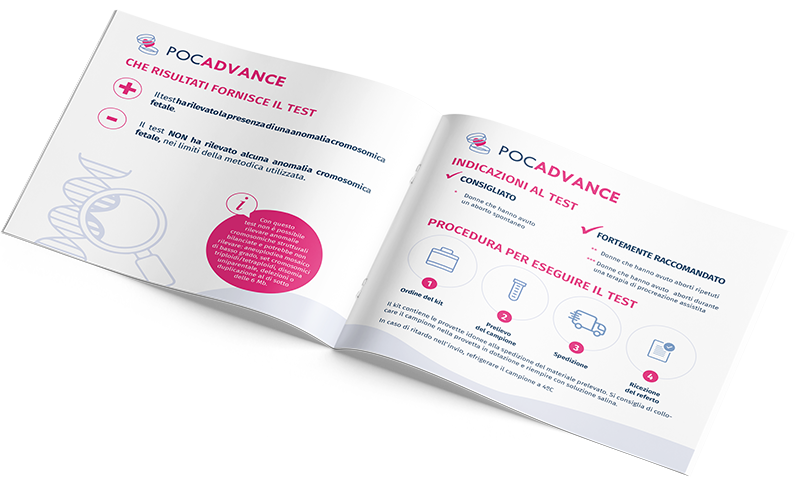
Request information about POCAdvance cfDNA GENETICS
Fill in the form for a free consultation. One of our geneticists will contact you, with no obligation, to provide all the information you need.